Features
Introducing Smart Pricing: Fill Quieter Hours Without Discounting Your Whole Business
Smart Pricing helps salons, barbers and beauty businesses target quieter periods without discounting their busiest hours, while keeping every pricing decision under the owner’s control.
Most salons, barbershops and beauty businesses have the same problem.
Some parts of the week are packed.
Others are not.
Friday afternoon might be almost impossible to book at short notice.
Saturday could be full weeks in advance.
But Tuesday at 2pm?
Wednesday morning?
That late afternoon gap between two appointments?
Those quieter periods can be much harder to fill.
The traditional answer is often to run a promotion.
The problem is that most promotions are too broad.
A business posts:
20% off this week
and suddenly gives a discount to customers who may have booked anyway.
That is not particularly smart pricing.
It is simply cheaper pricing.
Cobbtree Smart Pricing is designed to take a more targeted approach.
Instead of discounting your entire diary, Smart Pricing helps you apply promotional pricing where it can actually make a difference.
That means:
quieter times
selected services
specific days
defined booking windows
and, as Cobbtree builds enough booking history, recommendations about when Smart Pricing may be worth considering.
You remain in control.
Cobbtree helps you decide where to focus.
What is Smart Pricing?
Smart Pricing is a Cobbtree feature designed to help appointment-based businesses use pricing more intelligently.
Rather than permanently changing the normal price of a service, Smart Pricing can be used to create a targeted promotional price for selected availability.
For example:
10% off selected services on Tuesday afternoons
or:
Special pricing between 1pm and 4pm on quieter Wednesdays
or:
Fill selected last-minute availability with a limited-time promotion
The important part is that the offer does not need to apply everywhere.
You can use it where you actually want to generate more demand.
That makes Smart Pricing particularly useful for:
hair salons
barbershops
nail salons
lash and brow businesses
beauty salons
spas
massage businesses
mobile beauty professionals
independent hairdressers
aesthetic businesses
other appointment-led businesses
Why blanket discounts can cost more than they make
Imagine your Saturday diary is already nearly full.
You decide to run:
15% off all appointments this weekend
You may generate a few extra bookings.
But you may also give a 15% discount to clients who were already prepared to book at full price.
The promotion has therefore reduced the value of demand you already had.
Now compare that with Tuesday afternoon.
Suppose Tuesday between 1pm and 4pm regularly has empty capacity.
Those appointment slots exist whether somebody uses them or not.
A targeted promotion there can make much more commercial sense.
Instead of discounting the whole business, you are trying to convert unused capacity into revenue.
That is the idea behind Smart Pricing.
Target the quiet times, not the busy ones
Every business has its own demand pattern.
For one salon:
Monday may be closed
Tuesday afternoon may be quiet
Thursday evening may be busy
Saturday may be full
For another:
mornings may be strong
afternoons may be weaker
payday weekends may fill quickly
school holidays may behave differently
There is no universal "quiet day".
That is why Smart Pricing should work aroundyour business, not a generic timetable.
You decide where promotional pricing can apply.
And as Cobbtree builds up more history about your bookings, it can increasingly help identify where those opportunities may exist.
How Smart Pricing can work
A Smart Pricing rule can be configured around the parts of the business you actually want to influence.
That can include areas such as:
selected days
selected times
selected services
selected team members
selected locations
a start date
an end date
percentage discount
a fixed amount reduction
limited promotional periods
The goal is simple:
give the business control over when a promotional price should appear.
You do not need to reduce every service.
You do not need to discount every team member.
And you do not need to change your normal price permanently.
Example: a quiet Tuesday afternoon
Imagine a salon normally charges:
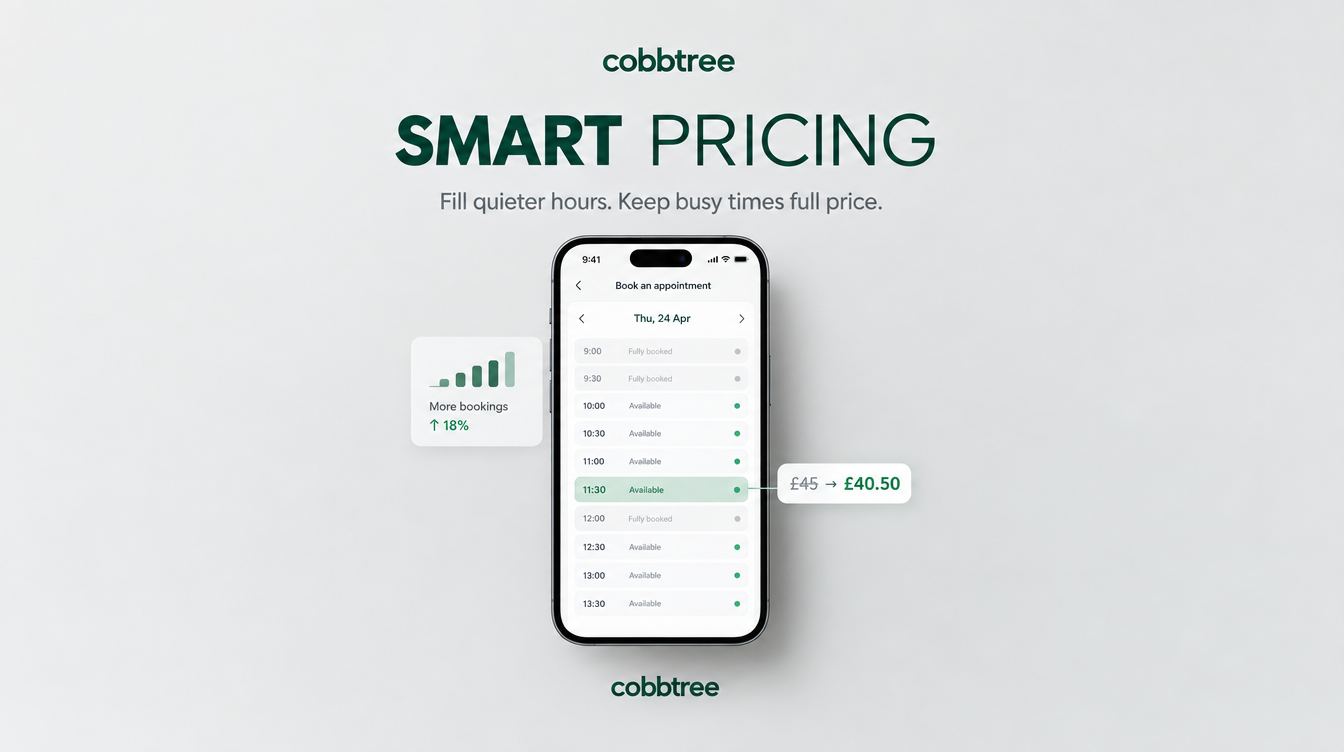
£45 for a Cut & Blow Dry
The business is normally busy on:
Thursday evenings
Fridays
Saturdays
But Tuesday afternoons regularly have spare appointments.
The owner could create a Smart Pricing rule:
Tuesday Smart Price
>
Tuesdays
1pm to 4pm
Selected Cut & Blow Dry appointments
10% reduction
The normal price remains:
£45
The qualifying Smart Price becomes:
£40.50
A customer booking an eligible Tuesday afternoon appointment can see the promotional price.
A customer booking on Saturday still sees the normal £45 price.
The business has therefore targeted the discount at the capacity it actually wants to fill.
Smart Pricing is not about becoming the cheapest
Cobbtree Smart Pricing is not designed to start a race to the bottom.
Price is only one reason a client chooses a business.
Customers also care about:
reputation
reviews
convenience
availability
location
expertise
experience
trust
quality
the person providing the service
Smart Pricing is simply another tool.
Used properly, it can help create demand around availability that may otherwise remain unused.
It should complement your pricing strategy, not replace it.
Your standard prices stay intact
A targeted promotion should not mean changing the price of the service everywhere.
That is important.
Your normal service can remain:
Cut & Blow Dry - £45
Smart Pricing can then apply only when the booking matches the rule.
For example:
Tuesday 2:00pm -£40.50 Smart Price
but:
Saturday 11:00am -£45 standard price
This allows you to protect the value of high-demand appointments while creating an incentive around lower-demand availability.
The customer gets a reason to choose a quieter appointment
Smart Pricing can also influence customer behaviour in a useful way.
Imagine a client can see:
Tuesday 2:00pm - £40.50
and:
Saturday 11:00am - £45
Some customers will still choose Saturday because convenience matters more to them.
That is fine.
But a price-sensitive customer may choose Tuesday instead.
The business has not simply sold an appointment for less.
It may have moved demand away from a highly desirable slot and into capacity that was otherwise harder to fill.
That can help make the diary more balanced.
Smart Pricing for salons
Hair salons often have complicated diaries.
A service may involve:
consultation
application
processing time
another service
finishing
multiple team members
different service lengths
That makes empty capacity particularly frustrating.
A small gap may be unusable for one service but perfect for another.
Smart Pricing can be used alongside the salon's booking rules to promote the services and times that actually make sense.
For example:
Tuesday afternoon blow dries
selected Wednesday colour appointments
quieter junior stylist availability
short-notice gaps for specific services
The business still controls which services qualify.
Smart Pricing for barbershops
Barbershops can have very obvious peaks and troughs.
Friday afternoon and Saturday may be extremely busy.
Earlier parts of the week may be quieter.
For a shop with several chairs, even a modest improvement in quieter-period utilisation can make a noticeable difference.
A barbershop could use Smart Pricing for:
selected weekday cuts
specific chair availability
quieter daytime appointments
selected services
short promotional windows
The point is not to discount Saturday when the chairs are already full.
The point is to create another reason for flexible customers to choose a quieter appointment.
Smart Pricing for beauty businesses
Beauty businesses can also experience irregular demand.
A nail salon may have quiet weekday mornings.
A lash technician may have a recurring mid-afternoon gap.
A massage business may have strong evening demand but weaker daytime bookings.
A mobile beautician may want to encourage bookings during specific working windows.
Smart Pricing gives each business the ability to decide where a promotional rate makes sense.
Smart Pricing for independent professionals
For a solo professional, one empty appointment matters.
There is no larger team absorbing that unused capacity.
If you have a two-hour gap in the middle of the day, that can represent a significant proportion of the day's possible revenue.
But independents also need to protect their time and their pricing.
Discounting every appointment is rarely the answer.
Smart Pricing allows the promotion to stay focused.
For example:
10% off appointments booked between 12pm and 3pm on Tuesdays
rather than:
10% off everything
That is a much more deliberate approach.
How booking history improves Smart Pricing recommendations
The most interesting part of Smart Pricing is not simply the ability to create a discount rule.
Businesses could do that manually already.
The bigger opportunity is using the information inside the diary to help decidewhen a promotion may actually be useful.
As a business uses Cobbtree, the system builds up information about:
booking activity
appointment times
service demand
utilisation
recurring quiet periods
recurring busy periods
team capacity
location capacity
cancellation patterns
historical availability
That information can be used to identify patterns.
For example:
Tuesday afternoons consistently have more spare capacity than the rest of the week.
or:
Thursday evening appointments are regularly at capacity.
Those are very different commercial situations.
Cobbtree can recommend when Smart Pricing may be worth enabling
The long-term goal is that you should not need to stare at the diary every week looking for patterns.
Cobbtree can do more of that monitoring in the background.
When there is enough useful booking history, the system can surface a recommendation such as:
Tuesday afternoons have shown lower utilisation over the last several weeks. Consider enabling Smart Pricing for selected services between 1pm and 4pm.
Or:
Wednesday morning availability has remained higher than your normal average. A targeted promotion may help fill these appointments.
The owner can then review the recommendation.
Nothing needs to change automatically.
You decide whether the suggestion makes sense.
The system recommends. You decide.
This is an important part of how Smart Pricing should work.
Cobbtree should help identify the opportunity.
The business should control the commercial decision.
A recommendation does not mean:
"Cobbtree has changed your prices."
It means:
"Cobbtree has noticed something you may want to look at."
You can then decide:
whether to enable Smart Pricing
which services to include
which people to include
which location to include
what the promotional price should be
when it should start
when it should end
That keeps the owner in control while reducing the work involved in identifying the opportunity.
Why not automatically change prices?
Because your business is more complicated than a graph.
There may be a reason a particular afternoon looks quiet.
Perhaps:
a team member is on leave
you have blocked the time intentionally
a local event affects demand
you do not want to discount a particular service
the quieter period is actually useful operationally
you want to protect your brand positioning
Software can identify patterns.
But the owner still understands the wider context.
That is why recommendations are more useful than blindly changing prices.
Smart Pricing can become part of a set-and-forget business
The best automation is often the automation you stop thinking about.
You should not need to spend every Monday morning asking:
"What should I discount this week?"
Instead, Cobbtree can monitor the underlying booking pattern.
If there is nothing worth your attention, you carry on.
If there is a meaningful opportunity, Cobbtree can surface it.
That is the same philosophy behind the wider Cobbtree platform:
configure the business once, automate the repetitive parts, and step in when your judgement is actually needed.
Smart Pricing and online booking work together
Smart Pricing becomes much more useful when it is connected directly to online booking.
A customer should not need to:
find an Instagram post
remember a promo code
phone the salon
quote an offer
wait for somebody to manually adjust the price
The qualifying promotional price can be presented as part of the booking journey itself.
The client sees the available appointment.
They see the relevant price.
They book it.
The diary updates.
The business knows why that price applied.
That creates a much cleaner customer experience.
No awkward promo codes
Promo codes can be useful in some situations.
But for targeted quiet-period pricing, they can create unnecessary friction.
Imagine trying to fill Wednesday afternoon.
You publish:
"Use WEDNESDAY10 at checkout."
Now the customer has to:
see the promotion
remember the code
choose the right service
choose the right time
type the code correctly
Smart Pricing can make the eligibility part of the booking rule itself.
If the appointment qualifies, the relevant price can be shown.
That is simpler.
Protect your busiest appointments
One of the biggest benefits of targeted pricing is what itdoes notdiscount.
If Friday evening is already full, leave it alone.
If Saturday appointments regularly sell out, keep them at standard price.
If one stylist already has more demand than they can handle, there may be no reason to promote their diary.
Smart Pricing can be focused on the places where you actually want additional demand.
That is the difference between:
running a sale
and:
managing capacity
Use Smart Pricing alongside your normal prices
Your normal price should remain the foundation.
Smart Pricing is the exception.
For example:
Appointment | Standard price | Smart Price |
|---|---|---|
Tuesday 2:00pm | £45.00 | £40.50 |
Tuesday 4:30pm | £45.00 | £45.00 |
Friday 3:00pm | £45.00 | £45.00 |
Saturday 11:00am | £45.00 | £45.00 |
The promotion exists exactly where the business wants it.
Not everywhere.
Smart Pricing is about utilisation, not just discounts
The important metric is not:
"How many discounted appointments did we sell?"
It is:
"Did we improve the use of capacity that would otherwise have remained empty?"
That is a much more useful question.
Imagine a salon had four regularly empty Tuesday appointments.
After enabling Smart Pricing, two of them begin filling consistently.
Even though those appointments are sold at a promotional rate, the business may still be better off because previously there was no appointment revenue in those slots at all.
That is the commercial idea behind targeted pricing.
Smart Pricing can help you test demand
Promotions can also provide useful information.
Suppose Wednesday mornings are consistently quiet.
You run a four-week Smart Pricing promotion.
If demand improves significantly, you have learned something.
Perhaps that customer segment is price-sensitive.
Perhaps the time works for people who are flexible.
Perhaps the service is more attractive at a slightly different price.
If there is almost no change, that is useful too.
Maybe price was not the reason those appointments were quiet.
You can stop the promotion rather than continuing to discount unnecessarily.
Better promotions with an end date
Promotions should not quietly become permanent.
Smart Pricing can be used with defined promotional windows.
For example:
Tuesday Afternoon Smart Pricing
>
Starts: 6 October
Ends: 3 November
The business can then review the result.
Did utilisation improve?
Was the offer commercially worthwhile?
Should it continue?
Should the discount change?
Should a different service be included?
That is much more controlled than reducing a price and forgetting why it was changed.
Your team does not need to memorise the promotion
Manual promotions can create another problem.
Staff need to remember them.
Was it:
10% off?
15%?
Only on Tuesdays?
Only before 3pm?
Does it apply to colour?
Does it apply to retail?
Does it apply to every team member?
When pricing rules are part of the system, the software can apply the configured logic consistently.
That means less confusion at checkout.
Better reporting
Because Smart Pricing sits within the same business platform as the appointment, Cobbtree can keep the promotional booking connected to the rest of the business data.
That makes it easier to understand:
which appointments used Smart Pricing
which services were promoted
when promotional bookings happened
how much promotional revenue was generated
whether the relevant period became busier
whether a pricing rule is still useful
The purpose is not simply to discount.
The purpose is to make a measurable commercial decision.
Smart Pricing should not create extra admin
A feature designed to improve quieter periods should not require the owner to spend hours managing it.
That is why the longer-term recommendation system matters.
The workflow should increasingly look like:
Cobbtree monitors normal booking activity.
A meaningful pattern appears.
Cobbtree surfaces the opportunity.
The owner reviews it.
The owner enables Smart Pricing if appropriate.
Cobbtree applies the rule to qualifying bookings.
The business reviews the result.
That is much closer to genuine business automation.
Example: five-chair barbershop
Imagine a barbershop with five barbers.
The shop is extremely busy:
Friday
Saturday
late Thursday
But Tuesday between noon and 3pm regularly has empty chairs.
The owner could create:
Tuesday Smart Price
>
Haircuts booked Tuesday
12pm to 3pm
Selected barbers
10% promotional price
Saturday stays untouched.
Friday stays untouched.
The business is not reducing the value of its strongest demand.
It is simply giving flexible customers another reason to use the quieter capacity.
Over time, if Cobbtree identifies Tuesday afternoons as a recurring under-utilised period, it can recommend that the owner review Smart Pricing rather than relying on the owner to spot the trend manually.
Example: beauty salon
Imagine a beauty salon offering:
nails
brows
lashes
facials
massage
The salon has strong demand after work and on Saturdays.
But facial appointments on Wednesday mornings regularly remain available.
Rather than running:
15% off everything this week
the business could create a focused offer around:
selected Wednesday morning facials
The promotion solves a specific problem.
That is the kind of use case Smart Pricing is built for.
Example: independent stylist
An independent stylist has limited capacity.
They work four days a week.
Most evenings fill naturally.
But Tuesday lunchtime often remains empty.
The stylist could choose to make selected lunchtime appointments slightly more attractive without changing the rest of the price list.
The client gets a choice.
The stylist protects their busiest appointments.
And the promotion can stop automatically when the configured period ends.
Smart Pricing and your brand
Discounting can make some businesses uncomfortable.
That is understandable.
Premium positioning matters.
Smart Pricing does not mean every business needs to run promotions.
It is optional.
A premium salon may decide never to use it.
Another business may use it only occasionally.
Another may use it around specific new services.
Another may use it primarily during seasonal quiet periods.
The feature is there when it makes commercial sense.
The business decides how it fits the brand.
Not every quiet period needs fixing
An empty hour is not automatically a problem.
Sometimes businesses need space.
A quiet period may be useful for:
cleaning
stock
training
administration
lunch
content creation
consultations
maintenance
That is another reason Cobbtree should recommend rather than automatically react.
The software can identify the pattern.
The owner decides whether the pattern is actually a problem.
Smart Pricing is one part of smarter diary management
Smart Pricing works best as part of a broader approach to diary automation.
Cobbtree is designed to connect:
services
pricing
team availability
online booking
client records
reminders
deposits
checkout
reporting
loyalty
business website
marketplace presence
A pricing decision is therefore not disconnected from the rest of the appointment journey.
It becomes part of the same system the business already uses to manage bookings.
From reactive management to useful recommendations
Traditional software tells you what happened.
Smart software should increasingly help tell you what is worth looking at.
Instead of:
"Here is your calendar."
the system can move towards:
"This part of your calendar regularly has unused capacity."
Instead of:
"Here are your reports."
it can move towards:
"This booking pattern may be worth your attention."
Instead of the owner looking for a problem, the software can help surface it.
That is the direction Cobbtree is taking with Smart Pricing.
Keep the final decision human
Smart Pricing should help businesses make better-informed decisions.
It should not make every decision for them.
Cobbtree can monitor.
Cobbtree can analyse.
Cobbtree can recommend.
But the business owner should still decide:
Yes, this makes sense for us.
or:
No, leave our prices as they are.
That balance is important.
Automation should reduce workload without reducing control.
Who is Smart Pricing for?
Smart Pricing can be useful for any appointment-based business that experiences changing demand.
That includes:
hair salons
barbers
beauty salons
nail salons
spas
massage businesses
lash technicians
brow specialists
mobile beauty businesses
independent stylists
multi-location salons
wellness businesses
It is particularly useful where some appointment periods are consistently harder to fill than others.
When should you use Smart Pricing?
Smart Pricing may be worth considering when:
a recurring period has spare capacity
you are introducing a new service
you want to encourage bookings at a particular time
a particular team member has available capacity
you want to test demand
you have short-term availability you want to promote
seasonal demand has dropped
you want to fill quieter weekday appointments
It may be unnecessary when:
demand is already very strong
appointments regularly sell out
the promotion does not fit your brand
price is unlikely to be the reason availability is low
you intentionally keep certain time free
Smart Pricing without the spreadsheet
The underlying idea is straightforward.
You should not need to export your diary into a spreadsheet to work out whether Tuesday afternoon is quiet.
You should not need to manually calculate utilisation every week.
You should not need to guess whether an offer might be useful.
The more Cobbtree understands about the way your business operates, the more useful those recommendations can become.
The business still makes the decision.
But the work required to reach that decision becomes smaller.
Built for the real world
Salons do not have perfectly predictable demand.
Neither do barbershops or beauty businesses.
Weather changes.
Seasons change.
Schools break up.
Christmas gets busy.
January behaves differently.
Staff change.
Services change.
Customer habits change.
That is why pricing tools should be flexible.
Smart Pricing is designed to help businesses react to the way their diary actually behaves rather than relying on a permanent discount strategy.
Smart Pricing in Cobbtree
Cobbtree Smart Pricing brings together three ideas:
1. Targeted pricing
Apply a promotional price only where you want it.
2. Diary intelligence
Use actual booking and utilisation patterns to understand where opportunities may exist.
3. Business control
Cobbtree can surface the recommendation, but you choose whether to act.
That means the software can become more helpful without becoming intrusive.
The goal: fewer empty slots, fewer unnecessary discounts
The best outcome is not:
"Everything is cheaper."
It is:
"We used our capacity more effectively."
If Smart Pricing helps fill an appointment that would otherwise have remained empty, it has done its job.
If a slot is already likely to sell at full price, leave it alone.
That is why the feature is calledSmart Pricingrather than simplyDiscounts.
Ready to try a smarter way to fill quieter appointments?
Your busiest appointments probably do not need a discount.
Your quieter ones might benefit from a little help.
Cobbtree Smart Pricing is designed to give salons, barbers and beauty businesses a more targeted way to promote spare availability without reducing prices across the entire diary.
And as Cobbtree builds more booking history, it can help identify when those opportunities may be worth your attention.
You set the rules.
Cobbtree watches the patterns.
You decide when to act.
Frequently asked questions
What is Cobbtree Smart Pricing?
Cobbtree Smart Pricing is a feature designed to let businesses apply targeted promotional pricing to selected appointments, times, services, team members or other qualifying availability rather than reducing prices across the whole diary.
Does Smart Pricing change all of my service prices?
No. Smart Pricing is intended to work alongside your normal service pricing. Promotional pricing can be limited to the qualifying appointments configured by the business.
Can I use Smart Pricing only on quiet days?
Yes. A key use case is applying promotional pricing to selected quieter days or times while leaving high-demand appointments at their normal price.
Can I choose which services use Smart Pricing?
Smart Pricing can be configured around selected services rather than requiring the entire service menu to be discounted.
Can Smart Pricing be used for specific team members?
Where supported by the configured rule, Smart Pricing can be targeted to selected parts of the business such as services, availability and team capacity.
Does Cobbtree automatically lower my prices?
Cobbtree's approach is to keep the business in control. Pattern-based recommendations can help identify when Smart Pricing may be worth considering, but the owner should review and approve the commercial decision.
How does Cobbtree know when my business is quiet?
As Cobbtree builds up booking history, it can analyse patterns in areas such as demand, availability and utilisation. That information can be used to surface periods that may deserve attention.
Do Smart Pricing suggestions use booking history?
Yes. Cobbtree analyses recurring diary availability and utilisation across an observation period. A newer business naturally has less history available, so useful suggestions depend on enough eligible diary data.
Can Smart Pricing help fill cancellations?
Smart Pricing can be useful around spare availability, including short-term gaps, where the business chooses to create a relevant pricing rule or promotion.
Is Smart Pricing the same as dynamic pricing?
It shares some ideas with dynamic pricing because price can vary according to defined circumstances. However, Cobbtree's approach is focused on business-controlled promotional pricing and recommendations rather than automatically changing prices without approval.
Can barbershops use Smart Pricing?
Yes. A barbershop can use targeted pricing around quieter periods, selected services or available capacity while keeping high-demand appointments at standard price.
Can beauty salons use Smart Pricing?
Yes. Beauty salons can use Smart Pricing for selected services or quieter appointment periods without reducing the entire price list.
Should I discount my busiest appointments?
Usually, the purpose of Smart Pricing is the opposite. If an appointment period is already consistently busy, there may be little reason to reduce its price. Smart Pricing is designed to help target capacity the business actually wants to fill.
Sources and methodology
This feature guide was checked on 1 October 2026 against Cobbtree's current Smart Pricing rules, booking-price calculations and suggestion analyser. Feature availability can depend on the selected plan, permissions and business configuration.
Smart Pricing supports scheduled off-peak, peak and last-minute rules. Suggestions analyse recurring diary availability and can recommend an off-peak or last-minute window. A suggestion does not change prices by itself. The business chooses whether to create and enable a rule, which locations, services and team members it covers, and its limits.
Written by
Cobbtree Editorial Team
The Cobbtree Editorial Team produces practical guides, industry information and product updates for beauty and wellbeing businesses.